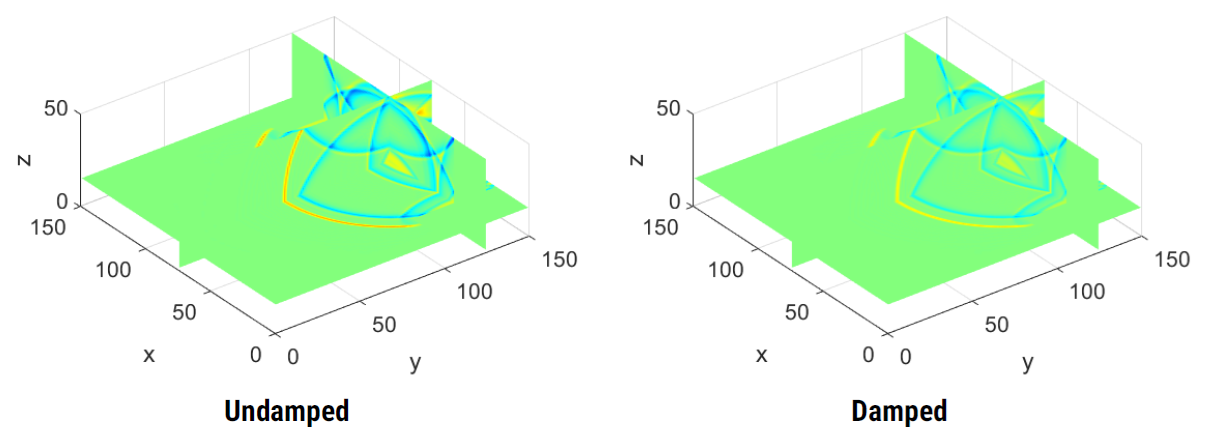
A new MOX Report entitled “Addressing Atmospheric Absorption in Adaptive Rectangular Decomposition” by Cicalese, G.; Ciaramella, G.; Mazzieri, I. has appeared in the MOX Report Collection. Check it out here: https://www.mate.polimi.it/biblioteca/add/qmox/48-2024.pdf Abstract: This paper focuses on the Adaptive Rectangular Decomposition (ARD) scheme, a wave-based method utilized for acoustic simulations. ARD holds promise for diverse applications. In architectural design, it can forecast acoustical parameters, facilitating the creation of spaces with superior sound quality. Moreover, in the domain of Acoustic Virtual Reality, ARD can offer users a more immersive and lifelike acoustic environment. Our enhancement proves advantageous for all these applications, enabling the simulation of larger environments with heightened precision. Despite its notable efficiency, ARD faces a significant drawback: the absence of atmospheric absorption modeling. The principal aim of this study is to rectify this limitation, thereby augmenting the capabilities of the ARD algorithm.