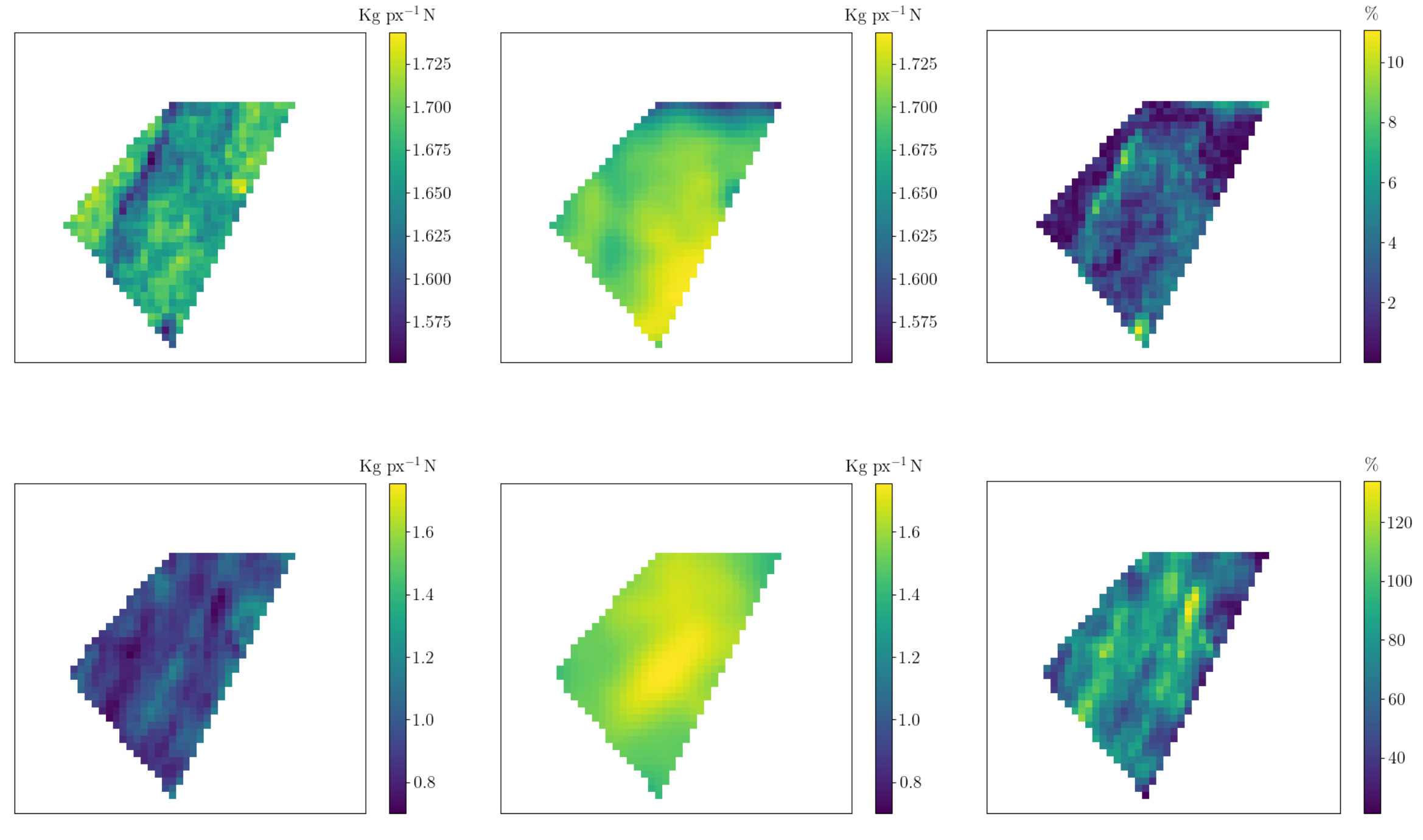
A new MOX Report entitled “Using SAR Data as an Effective Surrogate for Optical Data in Nitrogen Variable Rate Applications: a Winter Wheat Case Study” by Liverotti, L.; Ferro, N.; Soli, L.; Matteucci, M.; Perotto, S. has appeared in the MOX Report Collection. Check it out here: https://www.mate.polimi.it/biblioteca/add/qmox/73-2024.pdf Abstract: This study highlights the feasibility of using SAR data as a surrogate for optical acquisitions in the generation of nitrogen prescription maps in wheat cultivation. Unlike the optical-based approaches which are negatively affected by adverse meteorological conditions, the proposed strategy provides the possibility to compute the fertilization maps at any date, by exploiting the all-weather, day-and-night SAR capabilities. We train a U-Net-like CNN architecture on Sentinel-2 optical and Sentinel-1 SAR datasets, after a properly alignment in time. The trained model returns a surrogate NDVI distribution starting from SAR acquisitions, when optical data are not available. The recovered NDVI information is converted into LAI and GAI distributions, by resorting to an exponential and a linear law, respectively, according to the literature. Finally, the nitrogen prescription map is obtained out of the recovered GAI values. A qualitative and quantitative! analysis of the error between the optical and SAR-derived prescription maps shows that the procedure is accurate, especially during the tillering and the stem elongation growth phases.