A new MOX Report entitled “Physics-constrained identification of graph-based thermal networks for spacecraft digital twins” by Sosta, L.; Ciancarelli, C; Marini, L.; Pagani, S.; Regazzoni, F.; Parolini, N. has appeared in the MOX Report Collection.
Check it out here: https://www.mate.polimi.it/biblioteca/add/qmox/41-2026.pdf
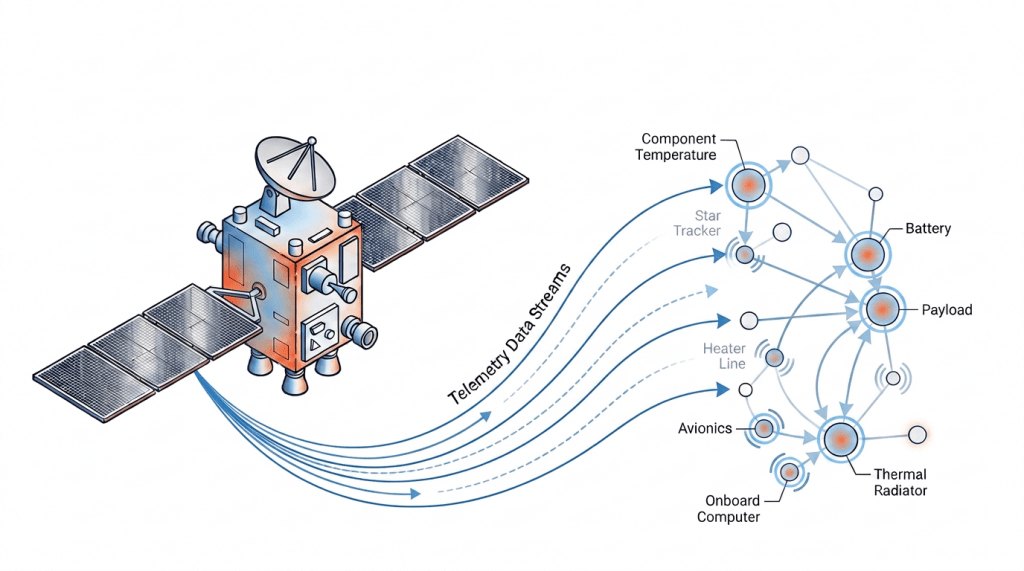
Abstract: Reconstructing a thermal model capable of efficiently simulating the behavior of a spacecraft from sparse and localized temperature measurements remains a challenging task. To address this, we introduce a physically-constrained calibration framework for Lumped Parameter Thermal Models (LPTMs), formulated as a trajectory-based inverse problem for graph dynamical systems. The model reconstructs thermal dynamics directly from temperature measurements and known inputs, without relying on a priori parameter values derived from material properties or geometric assumptions. Physical admissibility is enforced at the parameterization level: positivity of nodal coefficients and symmetry of conductive interactions are imposed by construction. This guarantees stable dynamics and restricts the identification problem to a physically meaningful parameter space, improving conditioning without the need of additional regularization. The identification problem is addressed through trajectory matching, ensuring stable rollout over extended time horizons. The methodology is validated on synthetic datasets generated from high-fidelity finite element simulations under progressively complex forcing conditions. The calibrated LPTMs accurately reproduce long-term temperature evolution and exhibit robustness to measurement noise. The proposed framework provides a systematic approach to the calibration of reduced-order thermal models by combining physical structure with data-driven identification. The numerical results show a favorable balance between accuracy and computational efficiency, making the models suitable for integration in spacecraft thermal Digital Twin applications.