A new MOX Report entitled ” Modeling time-varying genetic effects on binary disease risk via functional Mendelian Randomization” by Fontana, N.; Secchi, P.; Di Angelantonio, E.; Ieva, F. has appeared in the MOX Report Collection.
Check it out here: https://www.mate.polimi.it/biblioteca/add/qmox/57-2026.pdf
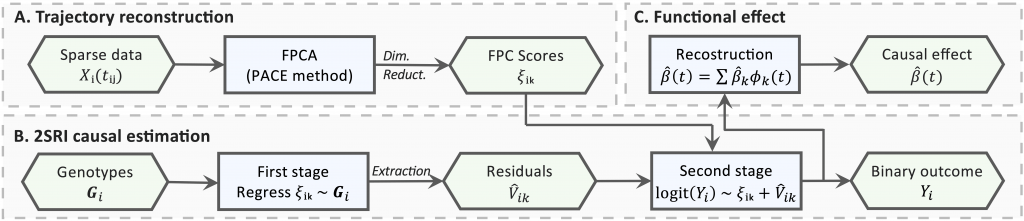
Abstract: Motivation: Genome-wide association studies have identified thousands of genetic variants associated with complex traits, establishing Mendelian Randomization (MR) as a powerful framework for causal inference using variants as natural experiments. However, existing MR methods treat causal effects as static, relying on cross-sectional exposure measurements and ignoring how genetic predispositions to disease operate dynamically across the life course. Recovering age-specific causal effect functions from longitudinal data requires combining functional data representations of exposure trajectories with instrumental variable estimation strategies suitable for binary disease endpoints, a methodological gap that has remained unaddressed. Results: We develop a functional MR framework for binary outcomes that integrates Functional Principal Component Analysis with Two-Stage Residual Inclusion (2SRI), ensuring consistent estimation under the nonlinear logistic link function that renders standard instrumental variable estimators inconsistent. Simulations across different causal effect trajectory shapes, varying measurement densities, and varying instrument strengths demonstrate accurate recovery of time-varying genetically predicted effects with minimal bias. Applied to UK Biobank data, the framework identifies an age-specific causal effect of genetically predicted body mass index on type 2 diabetes risk concentrated in early mid-adulthood and progressively attenuating thereafter. Concordance between the proposed 2SRI estimator applied to type 2 diabetes and the established continuous-outcome functional MR estimator applied to the paired glycated haemoglobin marker in the same cohort provides indirect empirical ! support f or the validity of the proposed approach. Availability and implementation: The method is implemented in the R package mvfmr, with a full tutorial vignette.